
 Admin
Admin If you are looking for the best augmented reality specialist trends in the future, I think your search ends here. You experience it when you put on virtual glasses from INDOCHINO, find a digital creature in your cellular recreation, or operate head-up navigation in a modern vehicle. Yet the delivery of these seamless digital touchpoints depends on an upskilled human who sits between the digital and the physical.
Creating interactive experiences like these requires a specific skill set, combining technical and creative skills. In fact, this has increased the need for professionals who work with technology so that organizations can implement it to engage audiences and solve complex problems more easily.
This guide will reveal the well-defined path you need to be successful with the precise skills you require. In this write-up, we will go over what an augmented reality professional truly does, the 7 most vital abilities needed to do it, the essential equipment that you need to understand, and how you can dive headfirst into your career.
What is an Augmented Reality Specialist?
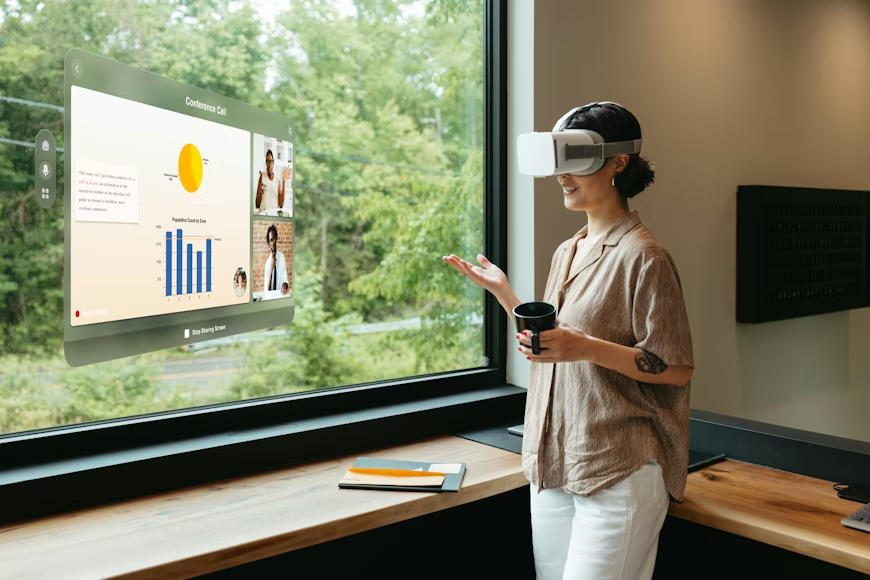
An AR expert is someone who is competent in the design, development, and implementation of AR applications. They project real-time images—3D models, text, and simulations—onto the physical world through cameras and sensors.
These experts are spread across multiple industry verticals. Those would be the folks who make retail applications that let you preview how furniture will look in your real living room before you buy. Their technology is used in healthcare as tools that give surgeons real-time data.
An AR expert needs to understand the limitations of mobile devices and AR glasses, as well as what it takes to deliver high-quality 3D graphics in real time. They are as much developers as designers and problem solvers.
Top 7 Augmented Reality Specialist Skills
You need to develop a diverse skill set to succeed in this role. The seven best skills to become an augmented reality specialist and gain as a winner
1. 3D Modeling and Design
However, augmented reality relies on 3D objects. Educating in creating rigging and animations for 3D assets, such that the 3D assets look believable and animate functions smoothly on consumer devices. How to manipulate polygon count, texture mapping, and lighting is one of the biggest factors in making a successful blend between digital remains and reality.
2. Programming and Software Development
Coding is the heart of any augmented reality application. Industry-wide, C# and C++ power most of the game engines. How does good object-oriented programming fit in the picture? Creating interactive mechanics, deciding on and choosing animation types, and handling logic for your AR apps require strong knowledge of object-oriented programming.
3. Spatial Computing and Mapping
Augmented reality (AR) applications must be cognizant of the physical “space” where they operate. Geometry and Spatial Mapping. Spatial mapping is the first of these subjects you need to know about because if you want augmented digital objects, such as 3D models rendered in your real-world environment on physical surfaces like floors and walls, then you need this to work. This is the mechanism of keeping an eye on device movement based on sensor data and mapping area geometry in motion.
4. UI/UX Design for AR
There is no traditional UI (a 2D AR interface); everything happens within a 3D environment. The skill in this case is the know-how to design usable menus and interfaces without being in the user’s line of sight. In an AR UX, good practice would incorporate ergonomics, voice commands, and gesture controls.
5. Computer Vision
Computer vision enables the device slab to identify real devices, faces, or markers through its camera. To overlay digital content precisely on these elements, you require a strong understanding of how computer vision algorithms track them. This ability identifies the difference between a table and a wall in your AR app, allowing you to place digital items where they are intended.
6. Problem-Solving and Debugging
Indeed, AR is so complicated and rarely predictable because, at the end of the day, you are working with real-world variables (changes in lighting and different physical environments). Debugging is a key requirement if you want to investigate why the digital object with user attention and its geo-coordinates are drifting from your target or why an application is completely draining your device’s battery.
7. Cross-Platform Deployment
Because your users will view your AR on a range of devices (an iPhone, an Android phone, or a standalone AR headset), you will have to be able to write and deploy AR apps to all possible OS’s as an AR developer.
Essential Tools
- It’s key to learn the right tools with the concept. Here are the fundamental software platforms that you need to learn:
- Unity, the most popular AR game engine, is available with the C# programming language, a powerful development environment, and cross-platform support.
- Unreal Engine is a high-fidelity graphics rendering engine. It uses C++ for those AR applications with a realistic target.
- ARKit is Apple’s platform for building AR experiences on its devices.
- ARCore is Google’s equivalent for the Android platform.
- Required: Blender or Maya, the tools used to model/animate 3D objects.
- Vuforia: image tracking SDK.
How to Become an Augmented Reality Specialist
So, in order to start on the right path for your journey into augmented reality, it is excellent that you have a fair balance between individual study and practice.
Step 1: Build solid coding fundamentals. Even then, C# or C++ gets a lot more attention because you will be writing a ton of code with them, as Unity and Unreal Engine are your go-to options. Countless free tutorials and paid courses can teach you these languages.
Next, start building small projects. Install Unity, then add AR Foundation (which sits in between ARKit and ARCore) and try to deploy a primitive 3D cube on the ground in your living room. With greater confidence comes larger and more complex projects. For instance, develop an application that identifies and plays a video of an image or places furniture objects in users’ environments.
And lastly, create a portfolio of your best projects to appear more professional. This is because employers want code samples and designs in action. Capture screen recordings of your AR apps running on real devices as videos. You should start contributing your work to GitHub and post it on LinkedIn and other platforms to meet industry developers who can help you with job opportunities.
Start Building Your AR Future
An augmented reality specialist job involves an equal mix of creation and artistry, with a solid dose of innovation. With 3D modeling, spatial computing, and programming skills under your belt, you put yourself in the pole position of an increasingly growing sector.
Just download a game engine and go through some basic AR tutorials today. The virtual and physical worlds are blending, and you can create experiences that bridge them.
FAQs
Augmented Reality Specialist Job Description?
The augmented reality developer blends AR experiences with real-world experiences by coding digital elements using 3D models, augmented reality apps, and smart devices.
We train you on technology through October 2023. What should your skill level be before you start as an augmented reality specialist?
ARR Specialists Skillset: Computer Graphics, 3D Modeling, Programming Skills (depends on simulation gaming), Spatial Computing, Computer Vision, User Interface/ User experience design
What exactly are the specialist tools to learn in augmented reality?
The augmented reality specialist must use ARKit, ARCore, Unity, and Unreal Engine to build powerful AR experiences; Blender is where we create high-quality animations/3D video content.
Here is the kind of chart that will do very well for AR spending on specialists in 2026.
With AR technology being used in gaming, healthcare, retail, and education, the augmented reality specialist career path is one of the fastest-growing.
How to become an augmented reality designer?
If you want to become an augmented reality expert, take C# or C++, work on AR projects with Unity, and compile a solid portfolio as proof of your talents.
